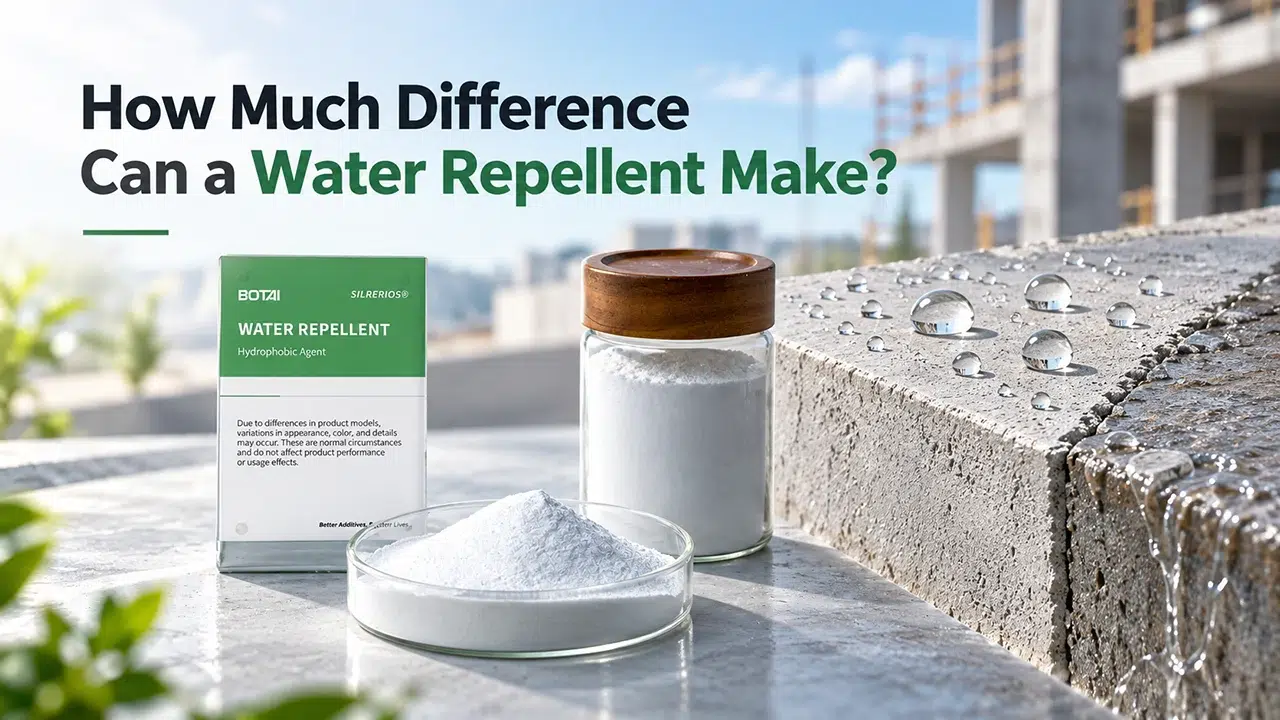
In decorative mortar, colored mortar, cement-based decorative materials, and other building materials with high appearance requirements, efflorescence and whitening have long been common problems that affect the final appearance of finished products and customer satisfaction.
When optimizing formulations, many manufacturers face a very practical question: Is it really necessary to add an alkali-depressant powder to reduce the risk of efflorescence?
From a purchasing perspective, alkali-depressant powder is a functional additive. Compared with common fillers and basic raw materials, adding another functional additive naturally increases the formulation cost.
For this reason, many manufacturers first focus on one question:
“How much extra will it cost per ton?”
However, if we look beyond the raw material purchase price and consider the entire product lifecycle—from production and application to project acceptance, after-sales service, and repeat business—the answer may be very different.

- Efflorescence Affects More Than Appearance
In cement-based systems, soluble alkaline substances can migrate through the material under the influence of moisture, temperature, curing conditions, and the surrounding environment. When these substances reach the surface and crystallize, visible white deposits may appear, resulting in efflorescence or whitening.
For some basic construction materials, slight surface changes may not cause serious problems.
However, for products such as:
Colored mortar
Decorative mortar
Cement-based decorative materials
Decorative cement products
Other systems requiring consistent surface color and appearance
efflorescence can directly affect color uniformity and the visual quality of the finished surface.
More importantly, once the problem appears after project delivery, the cost is no longer limited to the value of the affected material.
Technical teams may need to investigate the cause.
Sales teams may have to communicate with dissatisfied customers.
Contractors may need to return to the jobsite for repair.
In more serious situations, the issue may even delay project acceptance, payment collection, or future cooperation with the customer.
Therefore, the real cost of efflorescence can be much higher than the material loss itself.
- Why Are More Manufacturers Paying Attention to Alkali-Depressant Powder?
To help address efflorescence problems in cement-based systems, Botai Chemical provides Alkali-depressant Powder, designed to help improve the anti-efflorescence performance of formulations and reduce the risk of whitening and related surface appearance problems.
For manufacturers that care about product stability and final application performance, the value of Alkali-depressant Powder is not simply that it is “one more additive.”
Its greater value lies in helping manufacturers control potential problems from the formulation stage before they appear at the construction site.
Through proper formulation design and the appropriate combination of additives, manufacturers can improve product stability under real application conditions.
This is particularly important for products where surface color, appearance consistency, and long-term visual quality are important selling points.
It should also be noted that the final anti-efflorescence performance can be influenced by many factors, including cement type, fillers, pigments, polymers, water content, curing conditions, and the construction environment.
Therefore, the recommended dosage of Alkali-depressant Powder should be optimized according to the specific formulation and application through laboratory testing rather than relying on one fixed dosage for every system.
- The Real Cost Should Be Calculated Over the Entire Product Lifecycle
Suppose adding Alkali-depressant Powder slightly increases the production cost per ton.
The first reaction of some purchasing managers may be:
“Can we simply remove it to reduce costs?”
But manufacturers should also ask another question:
If we do not use it and efflorescence occurs later, how much could the problem actually cost us?
Potential hidden costs may include:
Technical troubleshooting and laboratory testing
Jobsite repair and labor costs
Project delays and additional management time
After-sales service and customer communication
Delayed project acceptance and payment collection
Damage to customer confidence and brand reputation
Loss of repeat orders or future business opportunities
These costs usually do not appear on the raw material purchasing sheet.
But they can have a very real impact on a company’s profitability.
From this perspective, adding Alkali-depressant Powder is not simply purchasing another functional additive.
It is also an investment in product stability, project delivery efficiency, and after-sales risk control.
- For Higher-Value Products, Stability Is Part of Competitiveness
Competition in the construction materials industry is becoming increasingly intense.
Competing purely on price is becoming more difficult, especially for manufacturers serving export markets, branded customers, engineering projects, and customers with higher quality requirements.
These customers do not only ask:
“What is your price per ton?”
They also care about whether the product performs consistently, whether the finished surface maintains a stable appearance, and whether the material creates additional repair or maintenance problems after application.
A low-cost formulation that continuously causes complaints, repairs, and after-sales problems may not actually be the lowest-cost solution.
On the other hand, if a carefully selected functional additive can improve product stability and reduce the probability of expensive problems later, the additional raw material cost may help save considerably more money over the full lifecycle of the product.
A mature formulation strategy is not simply about finding the cheapest raw materials. It is about finding the right balance between cost, performance, stability, and long-term customer value.
- Botai Chemical: More Than an Additive Supplier
Botai Chemical provides functional additives and solutions for dry-mix mortar and other construction material systems to customers around the world.
When it comes to Alkali-depressant Powder, our focus is not simply on supplying a bag of powder.
We are more concerned with helping customers evaluate efflorescence risks based on their actual applications, formulation systems, product positioning, and target performance.
If you manufacture colored mortar, decorative mortar, cement-based decorative materials, or other products affected by efflorescence and whitening, it may be more economical to evaluate the problem during the formulation stage rather than waiting until whitening appears after application.
Is your current product experiencing efflorescence, whitening, color inconsistency, or unstable surface appearance?
Are you unsure how Botai Chemical Alkali-depressant Powder should be incorporated into your existing formulation?
Or would you like to determine a more suitable dosage according to your raw materials and application requirements?
Send us your application, current formulation system, target performance, and expected purchasing quantity. The Botai Chemical team can discuss suitable product selection and testing recommendations with you.
Botai Chemical
Website: www.hnbotaichem.com
Email: [email protected]
WhatsApp: +86 199 0092 5762
Do not wait until efflorescence appears to calculate the real cost. Sometimes, solving one small formulation problem in advance can help prevent a series of much more expensive problems later.