Plastering mortar is widely used for interior and exterior wall leveling, surface protection, and decorative finishing. Although cement, sand, and fillers form the basic structure of plastering mortar, the final application performance depends heavily on the additives used in the formulation.
Among these additives, HPMC (Hydroxypropyl Methyl Cellulose) and HEMC (Hydroxyethyl Methyl Cellulose) play an important role in controlling water retention, workability, consistency, open time, and application properties.
For manufacturers of dry-mix mortar, choosing the right cellulose ether can significantly improve both construction efficiency and the quality of the finished wall.
Why Water Retention Matters in Plastering Mortar
Fresh plastering mortar contains water that is necessary for cement hydration and proper application. However, when mortar is applied to highly absorbent substrates such as concrete blocks, bricks, or aerated concrete, water can quickly migrate from the mortar into the substrate.
Excessive water loss may cause several problems:
- Insufficient cement hydration
- Reduced bonding strength
- Poor surface quality
- Rapid drying during application
- Increased risk of cracking
- Difficulty in leveling and finishing
This is where HPMC and HEMC for plastering mortar become especially important.
Cellulose ether helps form a water-retaining network inside the mortar, slowing down water migration and evaporation. As a result, the mortar maintains enough moisture for cement hydration and remains workable for a longer period.
Good water retention can therefore contribute to stronger adhesion, better curing, and more consistent finished surfaces.
How HPMC Improves Plastering Mortar
HPMC for plastering mortar is widely used because it provides a combination of water retention, viscosity control, and improved application performance.
When properly selected and dosed, HPMC can help the mortar achieve a smoother and more stable consistency. The mortar becomes easier to spread on the wall without becoming excessively fluid.
One important advantage is improved water retention. This helps prevent the substrate from absorbing water too quickly, especially under hot, dry, or windy construction conditions.
HPMC can also improve:
Workability: The mortar feels smoother during mixing and application, making it easier for workers to spread and level.
Consistency: It helps reduce segregation between water, cement, aggregates, and fillers.
Open time: The mortar remains usable for a longer period after application.
Sag resistance: Proper viscosity helps the mortar stay on vertical surfaces rather than sliding downward.
Surface finishing: Better consistency makes troweling and leveling easier, helping produce a more uniform surface.
For plastering mortar manufacturers, however, simply increasing HPMC dosage does not automatically provide better results. The correct viscosity, modification level, dosage, cement system, aggregate gradation, and other additives must be considered together.
What Does HEMC Offer for Plastering Mortar?
HEMC for plastering mortar performs many functions similar to HPMC, including water retention, thickening, and workability improvement.
Depending on the formulation and application conditions, HEMC can offer excellent construction performance, especially where temperature resistance and stable water retention are important.
In plastering mortar systems, HEMC may help improve:
- Water retention
- Workability and lubricity
- Mortar stability
- Anti-sagging performance
- Adhesion to substrates
- Application consistency
HEMC is therefore commonly considered for cement-based plaster, rendering mortar, skim-coat systems, and other dry-mix construction materials.
The choice between HPMC and HEMC should not be based only on product name or viscosity. Different mortar formulations can react differently to cellulose ethers, so practical formulation testing remains essential.
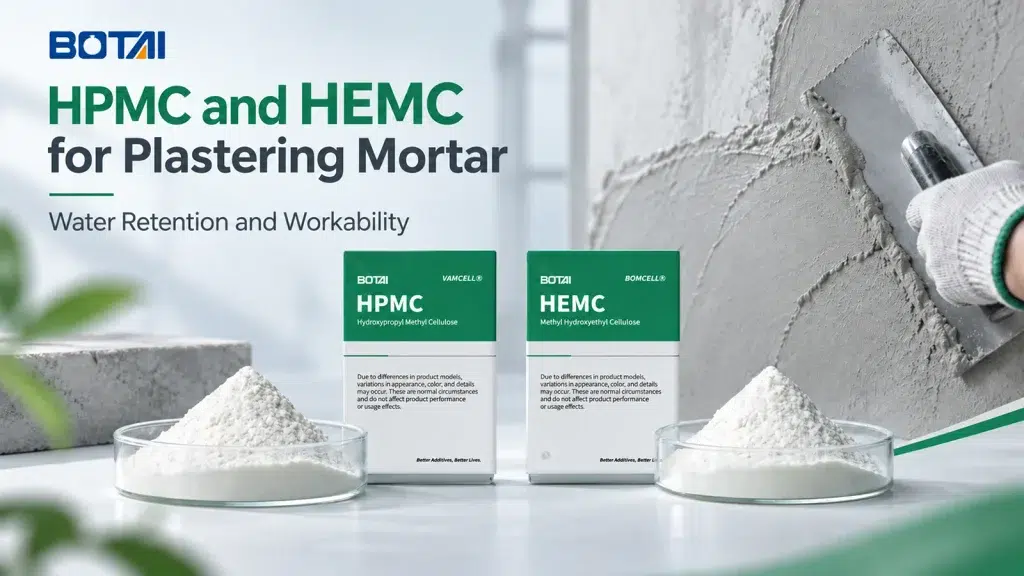
HPMC vs. HEMC: Which One Should You Choose?
There is no single answer suitable for every plastering mortar formulation.
For many manufacturers, the selection depends on several factors, including:
- Required water retention
- Desired mortar consistency
- Construction temperature
- Cement and filler composition
- Manual or machine application
- Required open time
- Local raw materials
- Target cost and performance
For example, a mortar used in a hot climate may require stronger water retention and better stability during application. A machine-applied plaster may require a different rheological profile compared with manually applied mortar.
Therefore, selecting cellulose ether should be based on the complete mortar system rather than one technical parameter.
Recommended Dosage and Formulation Considerations
The dosage of HPMC or HEMC in plastering mortar is usually relatively low compared with cement and aggregates, but even a small dosage change can noticeably affect performance.
Too little cellulose ether may result in insufficient water retention and poor workability. Too much can make the mortar overly sticky, increase viscosity excessively, or affect application speed.
Manufacturers should evaluate parameters such as:
- Water retention rate
- Wet mortar consistency
- Sag resistance
- Application feel
- Open time
- Adhesion strength
- Drying behavior
- Final surface appearance
Laboratory testing and job-site trials are strongly recommended before finalizing a commercial formulation.
HPMC and HEMC Solutions from Botai Chemical
At Henan Botai Chemical, we supply cellulose ether products including HPMC and HEMC for plastering mortar, tile adhesive, wall putty, skim coat, gypsum systems, and other dry-mix mortar applications.
Different mortar formulations require different viscosity grades and performance characteristics. Instead of simply recommending a standard grade, the better approach is to match the cellulose ether to your cement system, application method, climate, formulation, and required construction performance.
If your plastering mortar currently has problems such as fast water loss, poor workability, sagging, short open time, difficult troweling, or unstable consistency, send us your current formulation or describe the problem you are experiencing. Botai Chemical can help you evaluate suitable HPMC or HEMC grades and provide samples for formulation testing.
Contact Botai Chemical:
Website: www.hnbotaichem.com
Email: [email protected]
WhatsApp: +86 199 0092 5762
Your plastering mortar problem may not require changing the whole formulation—sometimes choosing the right cellulose ether is enough to make a noticeable difference.